Showing posts with label FAPLA. Show all posts

Tuesday, 21 October 2014

More AK 47 in Angola

Cuban Intervention Halts South African Invasion

The Guardian 26 July 1985

Sources in Luanda claim an invasion of Angola's southern Cuando Cubango province by South African forces has been halted after fierce fighting.

'For several weeks the apartheid regime has been sending tanks and mechanised troops over the border in support of CIA backed UNITA terrorists who are challenging the authority of the legitimate MPLA led Government of Angola,' said a spokesman in Havana.

'Cuban soldiers have assisted their Angolan comrades to fight off this assault, and after a series of battles have successfully expelled the South Africans from Angolan territory' he said.

'The South Africans have suffered heavy losses, particularly in their armoured formations, whilst Cuban and Angolan casualties have been minimal,' he said.

Sources closer to the front line in Angola's southern town of Menongue report heavy military traffic, all heading south, over the past week. 

If Havana has committed combat troops this could represent a major escalation of the so called 'border war' that has dragged on in this region for the best part of a decade since Angolan independence in 1975. Since the mid seventies, Cuban forces have largely been confined to garrison duties as well as providing training and logistical support for the MPLA Government forces. Most of the actual fighting in Angola has been between the western and South African backed UNITA rebels and the MPLA forces. Additionally, Pretoria has been fighting a low intensity war along the Namibian - Angolan border with SWAPO guerrillas who use bases in Angola for their efforts to destabilise South African occupied Namibia.

Washington alleges that East German and Soviet pilots and aviation technicians have recently been deployed in Angola. If true, this is further evidence that that Moscow is escalating a proxy war in southern Africa.


Cuban tanks take the objective - a destroyed MPLA T-34 marks the crest of the hill


 Cuban Motor Rifle troops seize the railhead - UNITA militia take cover in the background

A murderous little battle for a territorial objective - SADF mechanised infantry fight off  enemy T-34s, BTR 60s and infantry

In other words we've played three more games using the original AK 47 Rules. This has really given us fresh enthusiasm. Whether this will manifest itself in renewed interest sufficient to breath more life into these blog posts we'll see. When I started this blog the narrative was a much bigger part of things - we'll see...


Sunday, 24 March 2013

A Clear Victory - Now the People Demand Investment in Infrastructure!

We played a game of AK47 Reloaded yesterday and for the first time ever I managed a clear victory in a cross border incursion. My combined FAPLA-Cuban force successfully defeated a largely infantry SADF force despite losing two of the three objectives to the enemy.

The South African Paras were very professional, quickly occupying their objective, a built up area near a road entrance, without casualtiesand digging in. This deterred a Cuban tank unit from trying to take them on at close quarters. A good tactic for infantry faced with tanks in AK47, as in real life, is to hunker down inside built up areas so the armour has to close with them, allowing the footsloggers to close assault.


In the above picture you can see the Paras deployed in the built up area with the tanks approaching. The South Africans have just called in an airstrike, hence the explosion near the T-34s.


Elsewhere, a big unit of FAPLA militia successfully destroyed an SADF infantry unit in close combat although a second SADF unit secured the objective (the built up area with the crashed Mercedes objective marker). The destruction of this South African unit was to make a big difference to the Cuban-FAPLA victory points total.


In the above photo the marauding Cuban T-34s have just seen off a unit of SADF armoured cars. The vulnerability of armoured cars against tanks was underlined in this encounter. The South Africans were very brave in that they closed quickly with the tanks in order to maximise the effectiveness of their firepower. Unfortunately for them, this wasn't enough to knock out the  Cuban armour. What followed was swift and deadly - professional units get a re-roll when firing and armoured cars are not very well protected against high velocity armour piercing shot.

The game ended shortly after this with FAPLA having secured only one objective, digging in on the reverse slope of the gentle hill in the centre of the photograph. Communist casualties were light though and it was the body count that made all the difference in the end.

The upshot was that the SADF retreated back across the border at nightfall and the locals welcomed their liberation with calls for the Cuban engineers to sort out the roads and water supply!

Thursday, 28 February 2013

Operation Crossbow AK47 AAR

I'm in danger of confusing two alternative timelines as I have a Soviet invasion of Western Europe underway in 1981 using SPI's boardgame NATO as well my continuing Angolan Border War narrative that's reached the slightly earlier date of March 1979.

Readers will recall from earlier posts that the South Africans have launched a major external, codenamed CROSSBOW, into Angola to try and destroy SWAPO camps there. We've already played one table top battle using AK47 Reloaded rules and last night we fought our second.

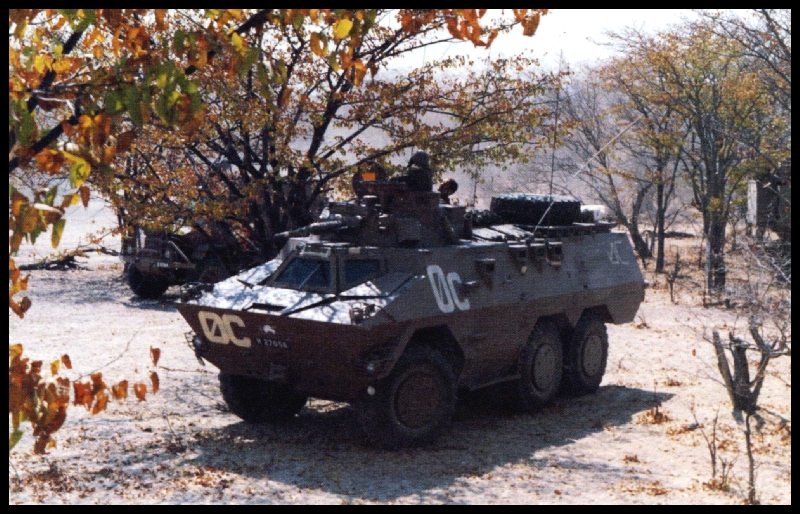
The situation was that a SADF mobile column was trying to seize a vital river crossing. A detachment from 32 Battalion, mounted in Landrover Technicals, spearheaded the advance supported by Eland Armoured Cars and Mechanised infantry from 62 Mech Battalion.

Above: SADF armoured cars storm into an Angolan village, at the top pf the picture FAPLA T-34s have just arrived
East German piloted MiGs attack the South African Armour

The Angolans were quick to react, deploying armour, in the shape of T-34 tanks and BRDM armoured cars crewed by Cubans, as well as a unit of Cuban motorised infantry. Two units of FAPLA militia were also part of the defending force.

This was dubbed a 'hot incursion' using the AK47 rules, and the SADF launched a feint against the objective in the village with their armoured cars before shifting the attack to the right flank against a hill held by a dug in unit of FAPLA militia.


The Angolans made the most of their assets, bringing on an armoured unit which was promptly the target of an SADF airstike. At the same time 32 Battalion's technicals entered the table behind the Angolan armour - a bold move but one that ultimately led to the liquidation of the South African unit as the Angolan tanks survived the airstrike and shot up the landrovers.

This was to prove the decisive episode in a close game - an Angolan airstrike against the SADF armoured cars knocked out one of them but couldn't stop the remainder shooting up the objective as the SADF infantry moved in. Alas for the Army of Apratheid, the game ended before they could secure the objective and once the points were totted up it was a clear Angolan victory!


Sunday, 10 February 2013

Ngiva AAR

 15 km inside Angola across the South West African Border there is a road junction. In March 1979 this was the place where the front in the war between South Africa and Angola was formed. The South African 62 Mechanised Battalion, the spearhead of Operation CROSSBOW found themselves attacked by elements of the Angolan 11th Motor Rifle Brigade. In the picture above the South Africans will try to secure the junction and the surrounding high ground - three gentle rises that barely qualify as hills.

Left: A South African  command element is trying to consolidate atop a low ridge south of the road. A knocked out Angolan T-34 is on the skyline and Angolan Air Force MiG 21s are being used in the fighter bomber role against the SADF troops.

Despite being caught in the open by the MiGs the South Africans managed to avoid suffering serious losses and successfully dug in on the hill, thereby securing one key objective.

The MiGs were flown by East German pilots and it's believed that the Communist forces experienced problems co-ordinating  air support with their ground troops.


Left: Angolan T-55s are brewed up by South African armour. The South African Olifants destroyed two thirds of the Angolan tanks but were surprised when the Communists kept closing the range and knocked out several Olifants.

The Angolan armoured troops were commanded by a cadre of Cuban officers and NCOs.


Below: South African troops have succeeded in consolidating on another of the low hills south of the lateral road. The Angolans have advanced in their BTR 60s into the woods at the foot of the slope and have disembarked their infantry but cannot cross the open ground dominated by the South African machine guns and RPGs.


The game ended with a clear South African victory as they held two of the three objectives. The Angolans successfully stormed the village north of the lateral road with two inexperienced units of infantry and managed to inflict some casualties on the SADF troops. The hill north of the village was also taken by the Angolans and with some firm leadership from the Cuban advisors they stayed put and dug in.

Both sides launched abortive airstikes and artillery support was notable for it's ineffectiveness.

A good fun game of AK 47 Reloaded that could have gone either way. The effectiveness of the South African armour was a nasty shock to the Angolans but the determination with which relatively raw Angolan troops maintained their attack into the village gave the South Africans something to think about.

Tuesday, 5 February 2013

15 March 1979: South of Ngiva

Captain Pieter Van der Horst's radio crackled:


'Enemy now within 3 kilometres of your position, mixed tanks and APCs, infantry dismounted'

Van der Horst looked at his radio operator, his eyebrows raised...there wasn't supposed to be any enemy armour in the area...

'Alpha One, this is Sierra Six, hostiles at location 485674, prepare for contact, shoot on my command, over'

'Roger Sierra Six, over'


Elements of the South African 62 Mechanised Battalion, supported by tanks from the School of Armour, are about to engage the the Angolan 11th Mechanised Brigade some 15 km inside Angola. The SADF forces crossed the border late last night, launching Operation Crossbow, the second major 'external' of the border war to date. Their objective was to disrupt SWAPO actvity in the border region, now they have encountered Angolan regular forces.

Our alternative timeline of the war in Angola is about to re-start. The guerilla war between SWAPO and the SADF and their South West African Territorial Force allies has been gradually escalating. The South Africans launched their first major incursion into Angola last year with an airborne assault on SWAPO at Cassinga. This was a military success but the political consequences have not been as favourable to South Africa - western public opinion is even more negative towards the Apartheid regime and Cuba and the Soviet Union have increased their support to the Angolan government.

Alerted by SWAPO forces on the border, Cuban and East German pilots flew reconnaissance missions at first light and have detected the SADF columns. Angolan forces and their Cuban advisors have moved swiftly to meet the incursion.

In other words, a game of AK 47 is scheduled for tomorrow evening...

Tuesday, 24 April 2012

Caxito AAR (2)

This proved to be a a lot of fun. The battle see-sawed for the whole game. The deployment rules ensured the shooting started straight away. The MPLA declared one of the building templates in Caxito and the large hill that dominated the diagonialy opposite quarter as objectives. The FNLA went for the road entrance at the table edge that was the most distant from Caxito in an attempt to get the MPLA to divide their forces.

This was not to be. The Cuban advisors ensured the MPLA deployed carefully, putting a full company of infantry on the hill and another, supported by the Command Group and HQ platoon, in Caxito.

The FNLA drove a company of technicals within HMG & AA range of the troops on the hill, but outside of effective range of their assault rifles and RPGs, and spent the rest of the game blasting away at them. The fact the MPLA successfully dug in on turn 1 mean they elected to soak up the pressure rather than charge across open ground at a line of Jeeps and Toyotas bristling with 30 and 50 cal machine guns and 20mm AA guns. Some losses were suffered but their morale held and the objective was never in danger.

The rest of the FNLA force focused on Caxito. Fighting in the town was bloody, largely as the MPLA elected to defend from within templates, rather than sitting at the edge and taking fire. In reality this would approximate to defenders occupying buildings within a built up area rather than on the outskirts, sacrificing the ability to fire at the attackers as they approached for the impact of ambushes with automatic weapons and grenades at short range. Most of the comabt was therefore close assaults.

The much vaunted Cuban supplied BM-21s MRLs proved largely ineffectual. Only one fire mission arrived and, as it was directed at infantry in a built up area, its impact was negligible. One can imagine the frantic calls for fire from the Cuban forward observer before his postion was overrun.

The battlefield with the MPLA postion on the hill in the foreground. In the built up area in the left background a desparate battle is raging...FNLA technicals can be seen by the road on the left.


As the mercenary led FNLA force fought their way into the township an understrength company of MPLA troops broke and fled. This proved the high water mark of the FNLA's fortunes however, for as they attempted to dislodge the Cuban Command group and HQ platoon, their advance stalled. The Cubans had fortified their postions and every building was either a strongpoint or booby trapped. Machine guns were deployed with mutually supporting arcs of fire and three or four man fireteams armed with AK47s and grenades were on hand to counter attack at any sign of the enemy penetrating their postions.

The FNLA mercenary leader, 'Colonel' Shannon had always suspected this would be a tough fight so was not unduly surprised when his usual tactics of charging the enemy in a blaze of automatic fire enjoyed limited success. The flight of the undertrained Angolan troops before his first assault was a bonus but he always expected a more determined, or better prepared, foe would put up more resistance.

Two things sealed the fate of the FNLA attack. The first was the booby trap that exploded as Shannon and his command group were clearing a cluster of buildings only metres from his Cuban counterpart's command post. The mercenary was mortally wounded and the attack lost its impetus. Shortly afterwards, a column of jeeps armed with recoiless rifles and HMGs arrived to reinforce the MPLA and took up postions on the outskirts of town, providing much needed support for the Cuban fighters. This column also ensured the third objective was denied to the FNLA.

So, the battle ended with a decisive victory to the communists. Luanda was secured and it now loks like an MPLA government will be installed in independence day on 11th November.

Caxito AAR (1)

This was the brief we used for the Battle of Caxito, played using Peter Pig's AK47 Reloaded rules with some adaptations


Caxito 3 November 1975


Situation


Task Force Blue, an FNLA unit originally of  brigade strength, has reached Caxito, about 30 kms from Luanda.

The Task Force is led by an Anglo-Irish mercenary and former Royal Marine Commando non commissioned officer, ‘Colonel’ Carlo Shannon. Since crossing the border with Zaire two weeks ago Shannon’s force has dwindled to around 1000 men, about 60 of whom are British, French and Portuguese mercenaries. They are well supplied and have plenty of transport in the shape of lorries, jeeps, landrovers and the ubiquitous Japanese built pick up trucks. There is no artillery support however, and morale is brittle.

FNLA cadre in Luanda have been decimated and guerrilla units in the surrounding countryside have been largely destroyed by the MPLA’s military wing, FAPLA. FAPLA is well armed with Soviet supplied light weapons such as AK 47s and RPG launchers. There are around 30 Cuban advisors fighting alongside the FAPLA front line units. At the end of October a Cuban registered ship, the ‘Vietnam Heroico’, docked in Luanda and unloaded a cargo of heavier weapons and ammunition. Half a dozen BM-21 multlple rocket launchers and the specialist  troops to operate them arrived with the cargo.

Against Shannon’s advice, the political leader of the FNLA, Holden Roberto, the brother in law of Zaire’s dictator, President Mobuto, has insisted that Task Force Blue launch an attack on the capital. Angola is due to be granted independence on 11th November, although Portuguese colonial rule has effectively already collapsed, and Roberto wants to install a government by then.

The fighting is bloody and confused. As Task Force Blue makes its bid to capture Luanda front lines cease to exist and a mobile free for all of attacks, ambushes and counter attacks ensues.


Deployment

The FNLA are the attacking force. Divide the table into four quarters. The FAPLA player chooses two diagonally opposite quarters and choose two objectives in these quarters. The FNLA player identifies another objective in either of these quarters.

The FAPLA player deploys two units in his quarter(s).

The FNLA player deploys three units in his quarter(s).

Forces


FAPLA


Commander & HQ stands (prof)

1st Company (militia)

6 x small arms
3 x RPG

2nd Company (militia)

6 x small arms
3 x RPG

Mobile detachment A (regular)

3 x HMG technicals

Mobile detachment B (regular)

3 x RCL technicals

The FAPLA player has an artillery asset of 12. This represents the BM-21 unit. Should it come into play it has the same effect as an airstrike so as to represent the devastating effect of massed rockets on morale.

FNLA


Command & HQ stands (prof)

Alpha Company (militia*)

1 x small arms stand (prof) mercenaries
5 x small arms (militia)
2 x Unimog Trucks

Bravo Company (militia*)

1 x small arms stand (prof) mercenaries
5 x small arms (militia)
2 x Unimog Trucks

Charlie Company (regular)

4 x HMG Technicals
1 x AA Technical

Delta Company (regular)

2 x HMG Technicals
1 x RCL Technical
3 x small arms
1 x Unimog Truck

* these units fight as regulars whilst the mercenary stand remains with them. As soon as it is destroyed or lost they revert to being militia

The FNLA player has an aggressive shot asset of 12, this represents the plentiful supplies of ammunition Shannon has been furnished with courtesy of the CIA.

Arrivals


Can be diced for from turn 2 as per the rules. The table edge of any enemy quarter is an enemy base edge and there are no ‘flank’ edges.


Victory


Countdown is from 21. At game end victory points are allocated as follows:

Defender


1D6 + 3 to offset numerical disadvantage and lack of mobility
D6 + 2 for each objective held
2D6 + 1 enemy command destroyed or fled
2D6 + 1 each enemy unit destroyed or fled
+ 2 for each template occupied by foot
+ 2 for each destroyed enemy vehicle
+ 1 for each destroyed enemy foot stand

Attacker


2D6 + 4 for each objective held
2D6 + 1 enemy command destroyed or fled
2D6 + 1 each enemy unit destroyed or fled
+ 2 for each template occupied by foot
+ 2 for each destroyed enemy vehicle
+ 1 for each destroyed enemy foot stand


Saturday, 21 April 2012

3rd November 1975: Task Force Blue Attacks

FNLA Troops begin the push on Luanda

FNLA troops, spearheaded by a battalion group led by Anglo-Irish mercenary Carlo Shannon, finally launched their attack on Luanda on 3rd November 1975.

Although Shannon's leading elements were only 35 km from the capital he was correct in anticipating a tough fight. The military wing of the MPLA, FAPLA, had been organising increasingly effective resistance and the fighting was bitter and confused.

By the second day of the attack, any semblance of front lines had disappeared as the protagonists fought in what could only be described as a free for all. Mobile units on both sides attacked and counter attacked, only to be cut off and ambushed. 


FNLA column reacts to MPLA ambush

Our next game in 'War for Slow Readers' will attempt to re-create this episode of the struggle...


Thursday, 22 March 2012

Battle of Menongue 25 October 1975


Outskirts of Menongue looking East. The South Africans attacked down this road.


We played the latest episode our camapign this week, the attempt by South African troops of Task Force Orange to link up with the paratroopers who had been dropped in to seize the airport at Menongue.

Both sides were given confiential breifings and objectives, together with how to achieve victory.

The scenario was an' exit' game involving a motorised SADF force entering the short table edge and having to fight its way across the table to exit on the opposite edge. The SADF had a detachment of Eland 90s and some Landrover technicals together with a company of infantry mounted in Buffel APCs and another in Unimogs.

The FAPLA defenders were three companies of militia with no heavy weapons.

FAPLA's only advantages were their ability to ambush the South Africans in the bush and built up areas and one company that had managed to dig itself in on the outskirts of town, directly in the path of the SADF advance.

FAPLA 'won' in that they prevented the South Africans exiting the table but if the game had gone on for another one or two turns the liklihood is that the result would have been different. FAPLA succesfully ambushed the SADF armoured cars and Landrovers but suffered heavy casualties and were losing ground in house to house fighting in Menongue itself when time ran out.

By evening on 25 October Task Force Orange had relieved 1 PARA and secured the airfield at Menongue.

Thanks to Chris and Evan for being such good sports an entering into the spirit of 'War for Slow Readers'

Sunday, 18 March 2012

An Airfield Too Far?

'Sunbeam, this is Harrier, the wicket is good over'

'This is Sunbeam, copy you Harrier, over and out'

'Time to move boys, those paras are waiting!'


1 PARA covers the airfield perimeter road

0600 25 October 1975: Bravo Company, 1 PARA, has seized Menongue airfield. Task Force Orange's spearhead has just been signalled to cross its start line and drive on Menongue to link up with the paras.

Major Christian van Fleet commands Battlegroup Sunbeam, a SADF motorised column and the spearhead of TF Orange.

Leiutenant Alberto Contador, Cuban Special Forces, has assembled three 'alarm' companies from the half trained FAPLA garrison of Menongue. His men have no heavy weapons and little hope of stopping the South Africans. The attack on the airfield came as a complete surprise, there had been no indication from either the FAPLA  command or his own superiors that the South Africans were prepared to use airborne troops .

Contador doesn't know the paratroopers' stength but he knows an enemy motorised column is operating in the area. He expects an attack from the south as the main South African force tries to link up with the airborne troops. He resolves to communicate news of the enemy advance to headquarters and to fight a delaying action in the town for as long as he can.

Thursday, 1 March 2012

Firefight at Folgares

Task Force Zulu was halted at Chibia. Although the casualties were relatively light in military terms, the political impact was such that Pretoria was unwilling to press on and risk further losses.

A debate ensued amongst the South Africans. The majority of military officers advocated allocating 'full blooded' support to TF Zulu by the SAAF and the deployment of airborne forces to quickly secure Lubango and its airfield. A minority view held that whilst FAPLA and its Cuban advisors had held the line at Chibia they couldn't do this everywhere and, instead of reinforcing failure, the SADF should make Task Force Foxbat's the priority axis of advance.

By 25 October Foxbat's leading FNLA battalion had reached Folgares where it had paused to regroup and resupply. The battalion's South African cadre of advisors, together with the bulk of the transport element, were some 5km south of the unit's main postion in the township itself. Two understrength infantry companies and the support company were deployed in the township. As evening approached these units were attacked in their rear by a full battalion of FAPLA regulars that had been completely missed by aerial reconnaissance.

FNLA Command Elements deployed in township
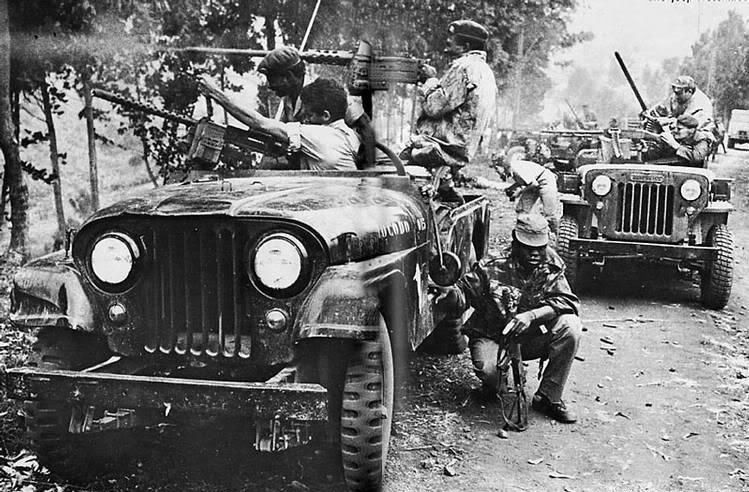
The ensuing firefight was confused and noisy. The FAPLA advance proceeded in fits and starts. One company entered the township but was fought to a standstill by FNLA troops that had dug in amongst the buildings in the town centre. Mortar and recoiless rifle fire, though largely inaccurate, seemed to intimidate the FAPLA troops and forestalled a close assault. To the west of Folgares FAPLA troops advanced cautiously and seemed reluctant to probe possible FNLA postions in dense bush. The arrival of an SADF armoured car platoon caused consternation amongst FAPLA's supporting mobile detachment of technicals until a lucky burst from a jeep mounted .50 cal machine gun disabled an Eland armoured car.

As dusk fell the fighting petered out. The FNLA held Folgares and had suffered no fatal casualties, although a dozen men were wounded. An Eland armoured car was written off and two more disabled, and there were several casualties amongst their South African crews, one of which was fatal. Three FNLA technicals had also been destroyed by very accurate fire from the FAPLA HQ platoon, composed mainly of Cuban advisors, For its part FAPLA had lost six dead and ten wounded with another three missing. Half a dozen Soviet built GAZ jeeps had either been destroyed or disabled by fire from the SADF armoured cars.

The FAPLA commander was dismayed, His men had not managed to press home their attack. The FNLA commander, Captain Mouriniho, was equally concerned. Although he had held the town, he never imagined that FAPLA were present in such strength in this area, nor that they had the wherewithall to mount an attack in such strength. 

In the small hours of 26th October Foxbat reported to Pretoria that their line of supply was insecure.

At the same time Cuban headquarters in Luanda received a report from their most senior officer in southern Angola that unless reinforcments were forthcoming he could got guarantee the security of Benguela and the coast road all the way to the capital.

Both sides believed their respective postions were hopeless...

Sunday, 26 February 2012

Chibia AAR

The battle at Chibia was fought using the AK47 Reloaded Rules and pitted a 416 point force of South Africans against 396 points of FAPLA troops led by a Cuban cadre.

The South African force (all regulars) consisted of:

Recon Company

3 x Eland Armoured Cars with 90mm (Standard) Guns
2 x Landrovers with HMGS
1 x Landrover with RCL

A Company

6 x stands Small Arms
3 x stands LAWS
Buffel APCs with HMGs as carrier allowance

B Company

4 x stands Small Arms
2 x stands LAWS
Unimog Trucks as carrier allowance

FAPLA had:

1st Company (Regular)

6 x Small Arms
3 x RPG

2nd Company (Regular)

6 x Small Arms
3 RPG

Anti Tank Platoon (Militia 'stiffened')

1 x Small Arms (Professional)
3 x RCL (Militia)

Cuban Mobile Detachment (Professional)

3 x GAZ Jeeps HMG
3 x Gaz Jeeps RCL 

We used the 'determined assault' rules for deployment and victory conditions. FAPLA started the battle with one understrength Company dug in in Chibia and the Cuban HQ deployed in dense bush outside the township. All South African troops were committed although some didn't arrive in time (this was the effect of the AK47 'reserves' system)

The most spectacular event was the successful ambush by the FAPLA anti tank platoon.

Burning landrovers can be seen in the left foreground. FAPLA infantry are dug in the buildings and the RCLs of the anti-tank platoon can be seen in the buildings across the road.

In the immediate foreground the remnants of the Cuban Mobile Detachment can be seen.

In the far background a burning Buffel is all that's left of 9 platoon.

The engagement ended in a decisive victory for FAPLA

Thursday, 23 February 2012

Agony at Chibia

'It was a nightmare! I've lost six of my mates - 9 Platoon is gone...'


Yesterday the spearhead battalion of Task Force Zulu attempted to seize the vital road junction at Chibia 'on the bounce' i.e. by way off a hasty attack off the march. The plan was to capture Chibia by midday and then drive hard to reach Lubango some 40 km away by nightfall. Lubango is a strategically important town on the road to Benguela, which in turn is the key to opening up the coast road to Luanda. Lubango has a functioning airfield and this is vital to the FNLA-SADF advance in our version of Operation Savannah. Because Task Force Zulu is larger in our alternative history than it was in reality it requires greater logistical support. The South Africans have committed a greater proportion of their air force to supporting our alternative Operation Savannah than they did in real life, both in terms of combat aircraft flying reconnaissance and interdiction and military and commandeered civilian aircraft airlifting in troops and supplies. Once Lubango's airfield is secure the South Africans plan to fly in reinforcements and supplies to support the advance on Benguela.

First though, the spearhead battalion, codenamed 'Streetgang', had to take Chibia.

Streetgang consisted of two motorised infantry companies, one in Unimogs and another in Buffels, and a composite squadron of Elland armoured cars and landrovers mounted with heavy machine guns and recoiless rifles. Lieutenant Colonel van Beer, Streetgang's commander, was ordered to attack at dawn and use speed and aggression to seize the township and clear the road north west to Lubango.

A combination of communication problems, navigational errors and vehicle breakdowns meant both infantry companies were under strength as zero hour approached. Colonel van Beer took the decision to attack anyway and Bravo Company quickly entered the township. Ominously, there was no sign of the civilian population and and as the troopies began to clear the houses they came under fire from FAPLA soldiers who were dug in in the buildings near the centre of town. 

Alpha Company, mounted in APCs, drove hard towards an area of dense bush to the east of Chibia and dismounted to clear the way for a short right hook that would seal the northern exit roads of the township. Here they ran into the headquarters of the FAPLA forces in the area- a platoon of Cuban instructors and the HQ staff of the Cuban-FAPLA battalion that was responsible for this sector. Committed piecemeal, the South Africans did not expect the ferocity of the response they received from the Cubans who were largely crack special forces troops. The firefight was at short range in thick scrub and 9 platoon, leading the South African attack was decimated. Alpha Company fell back in disorder.

Meanwhile van Beer's most mobile unit, the armoured car and technical squadron, had executed a wider envelopment across the savannah to the east of Chibia. As they drove across the rear of the FAPLA position they successfully engaged and destroyed a number of FAPLA vehicles seen approaching from the west along the Lubango road. Unknown to them, these were Cubans who had driven their technicals towards the sound of the guns as the fighting in Chibia broke out.


The FAPLA-Cuban commander, Major Jose Sanchez, was feeling under immense pressure. He only had an understrength company of regulars defending Chibia itself, supported by an anti tank platoon of barely trained recruits armed with recoiless rifles. He was short of ammunition, particularly rockets for the shoulder fired RPGs that his infantry were equipped with. An urgent appeal for assistance had resulted in assurances that mobile reserves were on the way but the sound of South African 90mm guns and a radio net clogged with panicking comrades led him to think the battle was lost.


He was unaware that his anti-tank platoon, led by Sergeant Torres, one of his best instructors, had sprung a successful ambush from concealed positions in the township. Half a dozen landrovers were brewed up by FAPLA rockets and Captain Grobelaar, leading the SADF armoured car and technical squadron, was forced to break off the engagement with the FAPLA reinforcements and seek cover.

By midday the South African attack had ground to a halt. Eight men were dead, six of them from the hapless 9 Platoon, and another 25 were wounded. Six landrovers and three APCs were destroyed or disabled.

Sanchez for his part, was hanging on grimly. His company had suffered on light casualties, none of them fatal, although the mobile column that was supposed to reinforce him had lost half of the armed jeeps that were its fighting strength together with 15 killed and wounded.

For the South Africans it was a clear tactical defeat - they had the means to maintain and apply more pressure but that meant more casualties and their timetable was in tatters. For FAPLA, the only question was how to extricate themselves: the South Africans may have been halted but it was only a question of time before the FAPLA postion was overrrun.

Saturday, 18 February 2012

Cahama 19 October 1975

The South African objectives were to secure the road entering the battlefield on the right, the crossroads over the bridge to the left and the road exiting the battlefield at the top of the picture.

A motorised company of FNLA militia was assigned to sieze the wooded area to the right of the river at the top of the picture and cross the river by the nearby ford; three FNLA technicals were ordered to drive over the bridge and take the crossroads in a coup de main; and an understrength company (two platoons) of SADF regulars were to secure the kraal in the right foreground. A full strength SADF infantry company, supported by six Elland armoured cars was in reserve. The accent was on speed and aggression: since crossing the border four days ago Task Force Zulu had not encountered any significant opposition from the MPLA or their Cuban allies.

The Bridge at Cahama

FNLA Technicals poised to charge over the bridge: the graffiti on the building on the right should have been a warning...


 The plan went wrong almost from the very beginning. The technicals drove across the bridge at high speed and ran into a well laid ambush at the crossroads. Cuban trained FAPLA troops, armed with recoiless rifles and dug in amongst the buildings, opened up on the softskinned FNLA column. Two thirds of the FNLA vehicles were knocked out immediately and as the remainder tried to retreat across the bridge they fell prey to pre-registered mortar fire.

The FNLA motorised infantry successfully approached the ford but were caught in withering fire from an understrength FAPLA militia company led by Cuban officers and instructors from their southern training camp. The FNLA retreated and went to ground.

The South African infantry approached the kraal with caution. Given the unexpected amount of firing and the confusion that was apparent from the radio traffic, their commander had decided a careful advance was called for. Once amongst the cover of the primitive dwellings, he was astonished to see half a dozen soviet built jeeps bristling with heavy machine guns drive at full speed over the bridge and take up position in the buildings where only half an hour ago the FNLA technical crews had eaten breakfast. He and his men spent the rest of the morning pinned down by machine gun fire. What he didn't know was that a Cuban special forces captain had commandeered the jeeps and, seizing the initiative, had driven straight through the FNLA position.

Securing the Kraal
The South African Commander acted decisively and committed his reserve. Fortunately for him Bravo Company had found the river to the south of Cahama to be easily forded and had outflanked the FAPLA position on its left. Even this good luck was limited however, as his troops entered dense bush and found themselves involved in close quarter combat with Angolan troops led by Cubans.

As night fell the South Africans counted the cost. All nine FNLA Technicals were destroyed, The FNLA infantry were refusing to move and his most successful unit had lost nine dead and over a dozen wounded. total casualties were 27 wounded and 14 dead. It was a disaster.

The Cuban commander made a quick appraisal of the situation. Astonishingly his men had suffered no fatal casualties although he had six wounded, one seriously. It was clear this was a large enemy force and the fighting in the bush by the river had left him in no doubt he was up against South African regulars with armoured support. Now wasn't the time for heroics.

As night fell the Cuban and FAPLA troops melted away and, under the cloak of darkness, headed north.

Thursday, 12 January 2012

Progress Report

Over the last couple of weeks I've completed all the Cuban/FAPLA infantry together with Mortars, Command and Recoiless Rifles. I've also painted all the South African infantry and started on the armoured support and soft skins.

I need to finish off the lattter and make some headway with the South African heavy weapons and paint up some odds and ends like 32 Battalion/Potuguese mercenaries.

Pictures to follwo in a couple of days.